Some nights, survival feels impossible.
You’re not actively trying to die—but you’re also not sure how to keep going. Maybe drinking used to take the edge off. But now, it only dulls things for a moment before making everything worse. The thoughts come back stronger. The emptiness lingers longer. The sleep is shallow, if it comes at all.
If that’s where you are, we want to start by saying: you’re not broken. You’re not weak. You’re not beyond help.
And no—this isn’t another lecture about hitting rock bottom or just choosing joy.
This is a quiet invitation to stay. One moment longer. One breath deeper. One conversation sooner than you thought you could have.
At Purposes Recovery in Los Angeles, we offer alcohol addiction treatment that sees the full picture. Not just your substance use. Not just your thoughts. But the whole, hurting, human you.
You don’t need to be sure. You just need to be honest—and willing to begin.
When Alcohol Is the Only Thing That Makes the Thoughts Stop
For many, alcohol starts as a coping mechanism.
A drink to wind down. A drink to sleep. A drink to not feel so much. To forget what you can’t fix. To silence the thoughts that echo louder than the world around you.
But alcohol is tricky.
Because over time, the very thing you use to feel better begins to blur the edges of safety and sadness. It lowers inhibition. It makes the darkness seem more inviting, more logical, more final.
And when that happens, drinking doesn’t stop suicidal thoughts—it speeds them up.
What began as comfort becomes a trap. The relief is shorter. The crash is deeper. The pain is sharper.
That’s not weakness. It’s chemistry. And it’s survivable.
“I Don’t Want to Die. I Just Don’t Want This.”
We hear it all the time. And it matters every single time.
This internal tug-of-war—between not wanting to die and not knowing how to live like this—is where so many people get stuck. It’s a hard place to be, especially when alcohol becomes your only tool for surviving it.
At Purposes Recovery, we don’t minimize this paradox. We respect it. We work with it. We meet people who live in that in-between space every day.
And we help them find their way forward—slowly, gently, with no pressure to “be better” before they’re ready.
Why Alcohol Deepens Suicidal Ideation
There’s a reason alcohol makes everything feel heavier—even when it starts by numbing you.
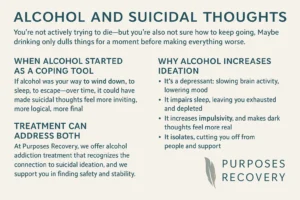
Alcohol impacts your brain in ways that directly increase suicidal ideation:
- It’s a depressant. That means it slows brain activity and lowers mood.
- It impairs sleep. You may pass out, but you’re not resting—leaving you mentally and emotionally depleted.
- It increases impulsivity. Suicidal thoughts that feel far away during the day can feel urgent and real after a few drinks.
- It disrupts judgment. Alcohol makes it harder to recognize that thoughts aren’t facts.
- It isolates. Drinking often cuts you off from the very people and resources that could help.
That’s a chemical reality—not a character flaw.
Alcohol Addiction Treatment Isn’t Just About Quitting Drinking
When someone is using alcohol to cope with suicidal thoughts, traditional treatment won’t cut it. You need care that understands the overlap. That sees the connection. That treats both with compassion and skill.
At Purposes Recovery in Los Angeles, we offer dual diagnosis treatment in Los Angeles, CA that meets you where you are, including:
- Trauma-informed therapy that never shames or pressures you
- Suicide-aware clinicians who listen deeply and respond gently
- Mental health stabilization—including medication, if needed, to support your mood
- Group therapy with others who’ve lived this, too
- Flexible care levels—from residential to outpatient—depending on your needs
We know that sobriety can’t be the only goal. Sometimes, the first goal is just staying alive.
What If You’ve Already Tried Treatment—and Still Feel This Way?
If you’ve done this before, if you’ve been in a program and still ended up back in the same place, we want to say this:
You didn’t fail. The treatment wasn’t wrong. But it may not have been the right fit for your pain.
Many programs aren’t equipped to address suicidal ideation alongside alcohol use. They focus on behavior, not emotional survival. They push abstinence, but not meaning. They talk about relapse, but not despair.
We do things differently.
We believe in building safety first—emotional, physical, relational. We believe in helping you find why you’d want to stay, before we ask you to give anything up. We believe in starting over without shame.
What If You’re Not Sure You Want Help?
That’s okay.
Ambivalence isn’t resistance—it’s trauma. It’s exhaustion. It’s the normal response to trying everything and still feeling empty.
We don’t expect you to walk through our doors full of hope. We expect you to come in tired, skeptical, maybe even numb.
We can work with that.
Sometimes, people say yes to treatment not because they believe it will work—but because they’ve run out of other options. That’s a valid starting point.
You don’t have to want help to deserve it.
You Don’t Need to Leave Los Angeles to Find Real Support
LA is a city of movement, of masks, of people who always seem to be doing better than they are. It’s easy to disappear here. To suffer in plain sight. To show up at work or class or brunch while quietly falling apart.
We see you.
Purposes Recovery is here in Los Angeles for people just like you—people who are still going through the motions while wondering how much longer they can.
You don’t have to go away to get help. You don’t have to vanish or go inpatient for 90 days. You can start right where you are.
And we’ll meet you there.
What Recovery Can Feel Like—Even If You’re Not Ready for That Word
Recovery doesn’t always feel like joy or clarity or transformation.
Sometimes, it feels like:
- Sleeping through the night without needing to drink
- Having one less bad day each week
- Crying in therapy and not apologizing for it
- Hearing someone else say, “Me too”
- Realizing you don’t want to die—and not being surprised by that thought
These are the kinds of shifts we work toward. Slowly. Together. With room to pause, doubt, and try again.
FAQs About Alcohol Addiction Treatment and Suicidal Thoughts
Can I start treatment if I’m still drinking?
Absolutely. Many of our clients begin while actively drinking. We’ll work with you to create a plan that honors where you are—not where someone else thinks you should be.
Will I be hospitalized if I tell someone I have suicidal thoughts?
Not necessarily. Unless you’re at immediate risk of harming yourself, treatment can continue without hospitalization. Our goal is to help you feel safe and supported, not punished.
What if I’m afraid to stop drinking because it’s the only thing that helps?
We understand. For many, alcohol has been a survival tool. In treatment, we never rip that away—we help you find alternatives that actually support your mental health long-term.
Do I have to talk about everything right away?
No. You control the pace. We’ll never push you to share more than you’re ready for. You’ll be met with respect, not interrogation.
How long does treatment last?
It depends. We offer several levels of care, and we work with you to build a plan that fits your life and your goals. There’s no one-size-fits-all timeline.
The Part of You That’s Still Here Deserves a Chance
Maybe you’re not ready to quit drinking. Maybe you’re scared of what will come up if you stop numbing. Maybe the idea of hope feels fake right now.
But if you’re still reading, there’s a part of you that hasn’t given up.
We want to meet that part. Protect it. Nourish it. Give it room to breathe.
Call us at (888) 482-0717 or visit our Alcohol Addiction Treatment in Los Angeles, CA to learn how we help people find hope again—even when it feels out of reach.
You don’t have to be okay to ask for help. You just have to be here. And you are.