
The first time I went to treatment, I stayed sober for almost four months. On paper, it looked like it worked.
But the truth? I still woke up every day feeling like my brain was on fire.
I was anxious all the time. I couldn’t sleep. My thoughts raced so hard at night that silence felt dangerous. And eventually, I went back to using—not because I wanted to party, but because I wanted relief.
That was the part nobody explained to me.
Stopping substances and healing mentally are not always the same thing. And for some of us, regular rehab only addresses half the problem. I didn’t realize that until I started learning about care for people dealing with both addiction and mental health at the same time through a dual diagnosis treatment approach.
I Thought Sobriety Was Supposed to Fix Everything
Nobody says this out loud enough: getting sober can uncover things you were numbing the whole time.
For me, it was depression. Real depression. Not “having a rough week.” The kind where brushing your teeth feels impossible and your own thoughts start sounding cruel.
In my first treatment program, we talked constantly about triggers, accountability, meetings, relapse prevention. Some of it helped. But nobody asked why I felt emotionally wrecked even when I was technically doing everything right.
So I started believing the problem was me.
That’s what happens to a lot of people who leave treatment feeling disappointed. They assume they failed, when really, important pieces of their mental health were never fully addressed.
I Wasn’t Craving a Drug—I Was Craving Quiet
That realization hit me hard.
People often think relapse starts with temptation. Sometimes it starts with exhaustion.
I remember sitting in my apartment one night after work, completely sober, completely miserable, staring at the ceiling thinking, I cannot keep feeling like this every day.
Using wasn’t about fun anymore. It was about escape. Relief. Slowing my own mind down for a few hours.
That’s why treatment can feel incomplete for people dealing with anxiety, trauma, bipolar disorder, PTSD, or depression underneath substance use. If the emotional pain stays untreated, sobriety can start feeling less like freedom and more like white-knuckling survival.
A lot of people don’t need “more discipline.” They need treatment that understands both problems are feeding each other.
The Program Wasn’t Bad—It Just Wasn’t Built for Me
This part matters.
I’m not saying all rehab fails people. I’m saying some programs are designed mainly around substance use, while others are built to treat mental health and addiction together from the beginning.
There’s a difference.
In my second round of treatment, therapy looked different. Conversations looked different. Staff didn’t treat my anxiety like background noise.
Instead of asking only:
- “Why did you relapse?”
They also asked:
- “What were you feeling before you relapsed?”
- “What symptoms were getting worse?”
- “What were you trying to escape?”
That changed everything.
It felt less like punishment and more like understanding.
You Can’t Heal a Storm by Cleaning the Floor
That’s the best way I can describe it now.
If someone’s internal world is chaotic, painful, or constantly dysregulated, simply removing substances may not create stability by itself.
You can mop the floor over and over, but if the ceiling is still leaking, the room keeps flooding.
For people struggling with both mental health symptoms and substance use, a co occurring disorders program can help connect those dots instead of treating them like separate issues happening by coincidence.
And honestly, that connection can be the difference between feeling broken and finally feeling understood.
The Shame Started Lifting Once Things Made Sense
Before that, I thought I lacked willpower.
I thought everybody else in recovery had some secret strength I didn’t.
But once someone explained how untreated trauma, depression, panic, or mood instability can drive substance use, my entire history started making more sense. Not as an excuse. Just context.
There’s relief in finally understanding your own patterns.
A lot of people carry unnecessary shame because they’ve only heard one version of recovery:
“Stop using and your life gets better.”
Sometimes life gets clearer first. Better comes later.
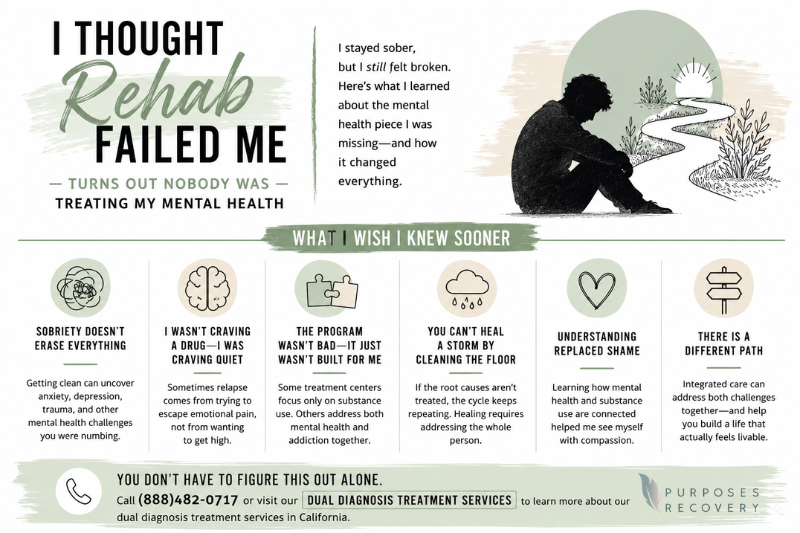
Skepticism Doesn’t Mean You’re Hopeless
If treatment didn’t work for you before, I get the hesitation.
You probably don’t want another sales pitch. You definitely don’t want someone talking to you like you “just weren’t ready.”
But there’s a meaningful difference between treatment failing completely and treatment missing something important.
That possibility alone is worth paying attention to.
Especially if you’ve stayed sober before and still felt emotionally underwater the entire time.
If that sounds familiar, it may help to explore whether support for both substance use and mental health together would feel different than what you experienced before.
You can learn more about dual diagnosis treatment services and what integrated care may look like for people who never felt fully understood in past treatment experiences.
Call (888)482-0717 or visit dual diagnosis treatment services to learn more about our dual diagnosis treatment services in California.