
I remember talking to a guy in treatment who said something I’ll never forget:
“I’ve already done rehab. It didn’t work.”
He wasn’t angry. He wasn’t defensive. He just sounded tired.
The truth was, he’d stopped drinking for a while. But the depression that had been sitting underneath everything was still there. A few months later, the drinking came back. Then the shame. Then the feeling that treatment had failed him.
If you’re searching for answers because depression and alcohol seem tangled together, you’re not alone. And if you’ve been to treatment before and felt disappointed by the outcome, that disappointment deserves to be taken seriously.
For many people, recovery starts to make more sense when they realize that alcohol wasn’t the entire problem. Sometimes it’s what they were using to survive the problem.
If you’re exploring options that address both issues together, learning more about treatment for mental health and substance use challenges can be an important place to start.
Sometimes Sobriety Doesn’t Fix the Thing That Hurt
A lot of people expect that once alcohol is removed, life will immediately feel better.
Sometimes it does.
Sometimes it doesn’t.
When depression has been present for months or years, stopping alcohol may remove one layer of pain while exposing another. Suddenly there are no distractions, no numbing, and no escape hatch.
That can be frightening.
It’s also one reason some people return to drinking after treatment. Not because they didn’t care. Not because they didn’t try. Because they were still carrying something heavy.
The Story I Hear Most Often
The pattern is surprisingly common.
Someone struggles with depression.
Alcohol becomes a way to quiet racing thoughts, loneliness, hopelessness, or emotional exhaustion.
At first it seems to help.
Then the drinking creates new problems. Relationships suffer. Work becomes harder. Sleep gets worse. Depression deepens.
Eventually treatment focuses on the drinking, but the emotional pain underneath never fully gets addressed.
Months later they’re asking themselves:
“Why am I back here again?”
The answer is often more complicated than a lack of willpower.
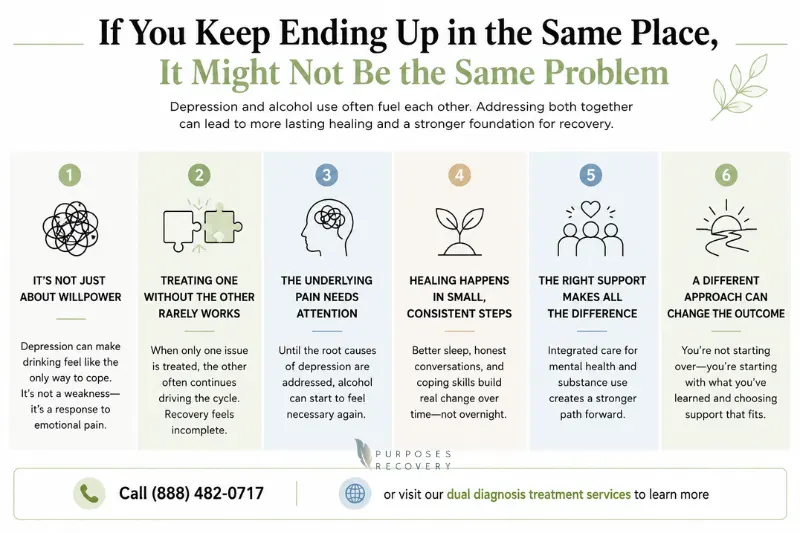
Why Treating Both Conditions Together Can Feel Different
One woman I met described it this way:
“For years everyone talked about my drinking. Nobody talked about why I wanted to disappear every night.”
That perspective changed everything.
When mental health and substance use collide, treating only one side can feel like fixing half a leak.
The water keeps coming.
Programs that address both conditions simultaneously recognize that depression and alcohol use frequently influence each other. Instead of asking which problem came first, the focus becomes understanding how both are keeping each other alive.
This is one reason many people seeking co-occurring rehab Los Angeles options begin looking for programs that can address the full picture rather than a single symptom.
Treatment Working Doesn’t Always Look the Way You Expected
One of the biggest misconceptions is that successful treatment creates an instant transformation.
For many people, it looks much quieter.
It looks like sleeping through the night.
Showing up for therapy even when you don’t feel like it.
Learning how to survive a difficult day without drinking.
Having one honest conversation you’ve avoided for years.
Recovery often unfolds in inches before it unfolds in miles.
If your previous experience didn’t create immediate life-changing results, that doesn’t automatically mean it failed. Sometimes it planted seeds that didn’t make sense until later.
What Changed for People Who Tried Again
The success stories that stick with me aren’t usually dramatic.
They’re ordinary.
A father who stopped waking up with dread every morning.
A woman who realized she hadn’t thought about drinking all week.
Someone who laughed naturally for the first time in years.
The common thread wasn’t perfection.
It was finally receiving support that acknowledged both the depression and the alcohol use instead of treating them as unrelated issues.
Many people in Los Angeles discover that a more integrated approach helps explain why previous attempts felt incomplete.
Skepticism Is Allowed
If treatment didn’t help the first time, you’re allowed to be skeptical.
You don’t have to force optimism.
You don’t have to pretend you’re excited.
You don’t have to believe every promise someone makes.
But it may be worth considering one possibility:
The treatment failed to address everything you were carrying.
That’s different from saying you failed.
And for some people, that distinction becomes the beginning of something new.
 A Different Question to Ask
Instead of asking:
“Why didn’t treatment work?”
Try asking:
“What part of my struggle never got addressed?”
That question opened a door for a lot of people I know.
Sometimes the answer was depression.
Sometimes it was trauma.
Sometimes it was grief, anxiety, or something else entirely.
But once the whole picture became visible, recovery started making more sense.
If you’re looking for support that addresses both depression and alcohol use together, Purposes Recovery offers care designed for people facing both challenges at the same time.
Call (888) 482-0717 or visit dual diagnosis treatment services to learn more about our dual diagnosis treatment services.