
When relapse enters the picture again, it rarely announces itself loudly.
It comes in sideways—missed calls, shift in tone, silence at dinner. You tell yourself not to panic, but your body already knows the truth. If you’re here, reading this, you likely love someone who’s struggling. And you’ve probably asked yourself: Is a residential treatment program really necessary this time?
That’s a heavy question. But the weight you feel doesn’t mean failure. It means you care. And Purposes Recovery’s residential treatment program in Los Angeles exists to meet families exactly at this crossroad—with clarity, compassion, and the kind of support that goes beyond crisis response.
What Is a Residential Treatment Program—and Who Is It For?
At its core, residential treatment is immersive care. It provides a safe, structured environment where a person can step away from daily chaos and receive round-the-clock therapeutic support.
Unlike outpatient therapy or IOP (intensive outpatient programs), residential care offers:
- 24/7 supervision and support
- Removal from triggering environments
- Consistent daily structure (meals, therapy, movement, rest)
- Access to multiple therapy modalities (individual, group, trauma-focused)
- Family integration—often including education, sessions, and communication support
It’s designed for people who are struggling to maintain recovery in their current environment—and for families who need to exhale, even briefly, knowing their loved one is safe.
How Do You Know If It’s Time for Residential Care?
There’s no perfect test. But when parents come to us, it’s often after weeks—or months—of watching patterns re-emerge that feel all too familiar.
Here are some signs that residential care may be appropriate:
Escalating or hidden substance use
If your child is using more often, hiding their use, or becoming defensive when asked, it may indicate a deeper issue than occasional slips.
Post-treatment regression
If they’ve been to treatment before but aren’t sustaining progress—and outpatient care hasn’t stabilized things—residential might offer a better foundation.
Emotional volatility
Mood swings, irritability, flatness, or apathy can signal internal struggle—even if substance use isn’t visible.
Disconnection from life
Are they missing work or school? Sleeping odd hours? Losing interest in people or activities they once cared about?
Safety concerns
If you’re worried about overdose, unsafe relationships, or impulsive behavior—trust that instinct. Even if your loved one denies there’s a problem.
These are not signs of a bad kid—or a bad parent. These are signs of someone in pain, trying to cope with something bigger than they can manage alone.
Why It’s So Hard to Decide—and Why That’s Normal
Many parents wrestle with guilt or fear when considering residential treatment. You might think:
- “Isn’t this too extreme?”
- “What if it pushes them away?”
- “We already tried treatment—what if this doesn’t work either?”
- “Will they hate me for this?”
These questions are valid. And they don’t make you weak or overreactive. They make you human. Especially if your child is a young adult (18–25), where autonomy, independence, and boundary lines become harder to navigate.
But here’s something many parents don’t hear enough:
Loving someone doesn’t mean fixing it alone.
It means recognizing when more help is needed—and being brave enough to ask for it.
What Happens Inside a Residential Program?
Each residential treatment center varies, but at Purposes Recovery, we focus on whole-person healing in a calm, clinically grounded environment.
Clients receive:
- Daily individual therapy with licensed clinicians
- Group therapy focused on emotional regulation, trauma recovery, and peer connection
- Family therapy sessions to rebuild communication and reduce conflict
- Psychoeducation to help clients understand addiction, co-occurring disorders, and emotional patterns
- Holistic supports such as yoga, art therapy, nutrition, and mindfulness
- Transition planning to support the next step—whether that’s IOP, sober living, or home
And parents are part of the picture—not blamed, not sidelined, but invited in.
Residential Treatment Isn’t Just for the Client—It’s for the Family, Too
We often hear: “I just want my kid to be okay.” But sometimes, what’s really needed is for the entire system to reset. That means:
- Learning how to set boundaries that feel sustainable
- Understanding the difference between support and enabling
- Grieving expectations that no longer serve your family
- Connecting with other parents who’ve been where you are
We don’t ask you to do this perfectly. We ask you to show up with the love you already have—and let us carry some of the load.
Why Los Angeles?
Choosing a residential treatment program in Los Angeles offers more than geography—it offers access to experienced clinicians, strong alumni communities, and a city where recovery isn’t just possible—it’s visible. Whether your young adult is from California or coming in from another state, Los Angeles can be a place to pause, reset, and reconnect.
FAQ: Residential Treatment for Young Adults
Is residential treatment only for severe addiction?
Not at all. Many people enter treatment due to mental health struggles, trauma, or emotional instability that’s impacting their lives—even if substance use is mild or secondary.
What if my child doesn’t want to go?
That’s common. We can help you navigate that conversation with care and clarity. In some cases, interventions or structured support conversations can help them see the benefit.
Will I get updates as a parent?
Yes. With consent, we involve families in communication, treatment planning, and therapy. You’ll never be left in the dark.
How long does residential treatment last?
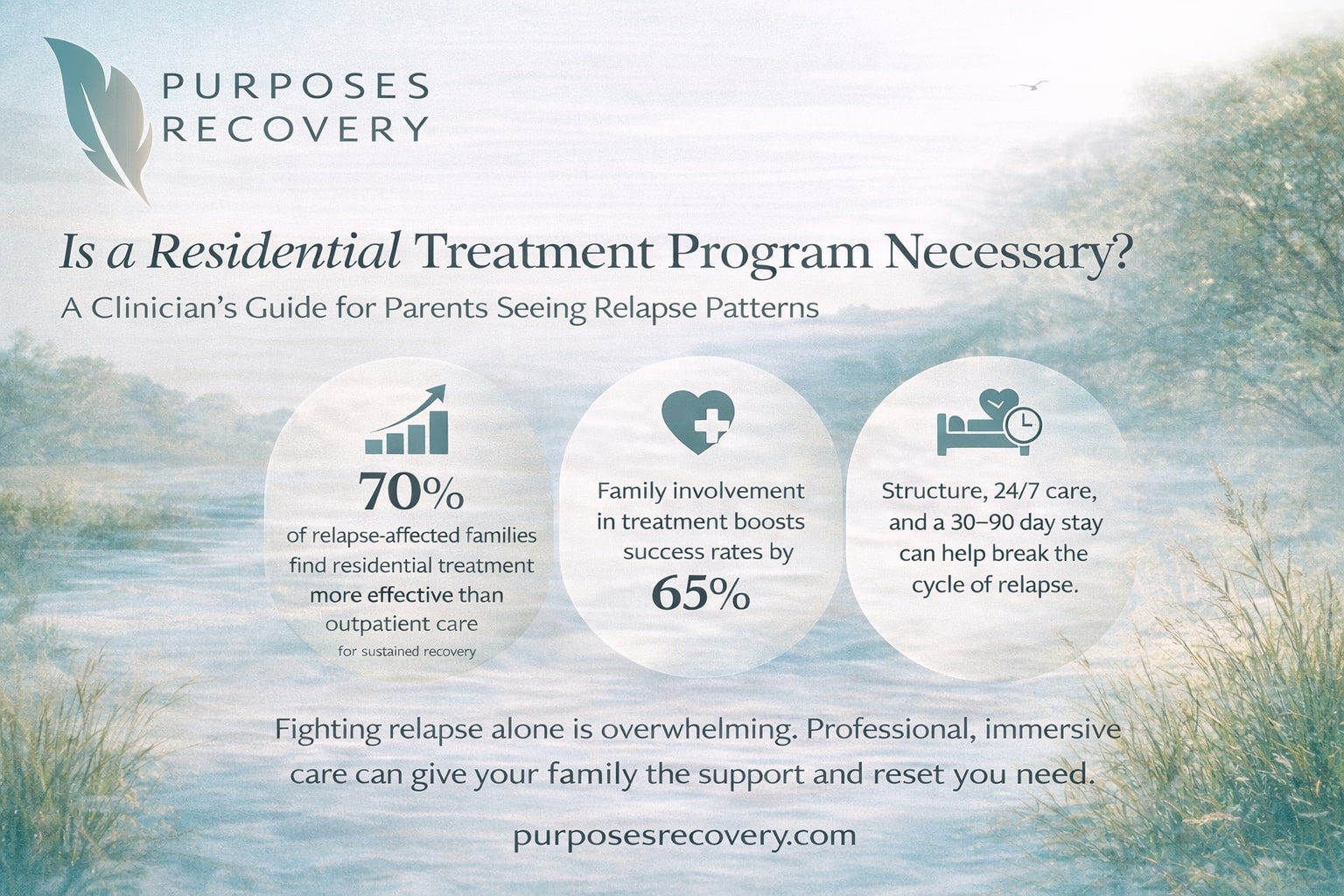
Programs typically range from 30–90 days, depending on needs and progress. Our team works closely with you and your child to create a transition plan early on.
What happens after residential care ends?
We support clients through aftercare planning, including step-down services like IOP, therapy referrals, sober living, or continued family support.
📞 You’re Not Alone in This
If you’re noticing signs of relapse or emotional distress in your young adult, trust your gut—and know you don’t have to figure it out alone. Call (888) 482-0717 or visit Purposes Recovery’s residential treatment program in Los Angeles, Illinois, Indiana, Missouri, New Jersey to learn how we can support your family. Even in moments that feel heavy, hope is never off the table.