
You’ve tried giving them space. You’ve tried checking in. You’ve tried saying less, then saying more. And still, something feels off—like you’re watching them slip further away, even when you’re doing everything you can.
From a clinical perspective, this is often the moment families start to wonder if a different kind of support is needed.
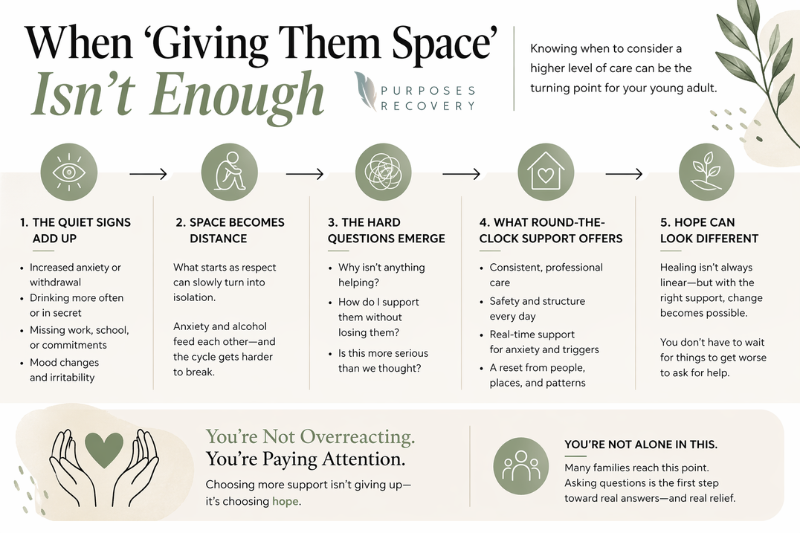
The Quiet Shift Parents Notice First
It’s rarely one big, dramatic event.
More often, it’s a series of small changes:
- Missed work or school days
- Increased anxiety or withdrawal
- Drinking that feels less social and more necessary
- A tone in their voice that sounds… tired
Parents will say, “They’re still functioning—but not like themselves.”
That distinction matters.
When anxiety and alcohol start feeding each other, it can create a loop that’s hard to interrupt without more structured care. Many families searching for alcohol and anxiety help arrive here—not in crisis, but in quiet concern that keeps growing.
Why “Space” Stops Working
Giving space comes from love. It says, I trust you. I don’t want to push you away.
But sometimes space unintentionally becomes distance.
Young adults struggling with both anxiety and substance use often interpret space as:
- “No one really sees how bad this is”
- “I can keep managing this on my own”
- “I’ll deal with it later”
And anxiety thrives in isolation.
Without consistent support, the internal pressure builds. Drinking becomes a way to take the edge off—but it also deepens the anxiety over time.
So what started as a respectful step back can turn into them feeling more alone inside something they don’t fully understand.
The Moment Parents Start Asking a Different Question
There’s usually a turning point.
It sounds like:
- “Why isn’t anything helping anymore?”
- “How do I support them without losing them?”
- “Is this more serious than we thought?”
This is not a failure of parenting.
It’s a recognition that the level of support needs to match the level of struggle.
And sometimes, that means looking beyond weekly therapy or occasional check-ins.
What Round-the-Clock Support Actually Changes
For some young adults, healing requires stepping out of their current environment entirely.
Not as a punishment—but as a reset.
In a live-in setting with consistent care, several things happen at once:
- The pressure to “hold it together” drops
- Anxiety is addressed in real time, not just in sessions
- Drinking patterns are interrupted safely and consistently
- Daily structure replaces chaos
One parent shared:
“It was the first time in years I felt like someone else could hold this with me.”
That sense of shared responsibility is often where hope starts to return.
A Story That May Feel Familiar
A 20-year-old we worked with had been trying to manage anxiety on their own for years. Drinking started as a social thing, then became a nightly routine.
They were still working. Still showing up. But barely.
Their parent described it as “watching someone tread water for too long.”
After entering a more structured, supportive environment, something shifted—not overnight, but steadily.
Sleep improved first. Then anxiety softened. Then came moments of clarity they hadn’t had in years.
It wasn’t about fixing everything.
It was about finally having enough support for things to begin changing.
Knowing It’s Okay to Consider More Support
This is the part many parents wrestle with.
Is it too much? Too soon? Will they feel like I’m giving up on them?
In reality, considering a higher level of care often means the opposite.
It says:
- “I see how hard this is for you”
- “You don’t have to carry this alone”
- “We’re willing to do something different because you matter that much”
If you’re starting to explore options, you can learn more about what that level of care looks like through this residential treatment program in Los Angeles.
You Don’t Have to Wait for It to Get Worse
One of the hardest myths parents carry is the idea that things need to fall apart before they qualify for real help.
They don’t.
Support works best when it meets people where they are—not where things finally break.
If your instinct is telling you that something deeper is going on, it’s worth listening to that.
A Gentle Next Step
You’re not overreacting. You’re responding to something real.
And even if your child isn’t ready to say it out loud yet, the combination of anxiety and drinking is exhausting to carry alone.
There are ways to support them that don’t rely on guesswork or constant worry.
Call (888)482-0717 or visit our treatment in Los Angeles to learn more about our Residential Treatment Program services in Los Angeles, CA.