
Sometimes, life pulls you away from treatment—and not always for dramatic reasons. Maybe things got hard and you didn’t know how to say so. Maybe you ghosted because you didn’t want to admit how much you were struggling. Or maybe you were just tired.
However you left, this is your reminder: you’re not alone, and you’re not disqualified from coming back.
If you’re thinking about reentering a residential treatment program in Los Angeles, you don’t have to overthink it. You just need a place to land—and a little guidance on how to take that first real step.
Let’s talk about what preparing to return can actually look like.
You Don’t Need a Perfect Reason for Leaving
First, let go of the idea that you have to explain yourself. Treatment isn’t a test you failed. Life happens. Emotions get overwhelming. Systems don’t always meet our needs. Sometimes, ghosting is survival—even if it’s messy.
Maybe you left because you felt stuck. Maybe you weren’t ready. Maybe you just couldn’t show up one more day.
All of those are valid. You don’t need to justify yourself to deserve help.
Acknowledge the Part of You That Still Wants This
Even if doubt is loud right now, some part of you is still trying. The part that clicked this blog. The part reading these words. That matters.
Before doing anything logistical, take a minute to acknowledge that small part. Write down:
- What made you leave?
- What’s drawing you back now?
- What would you want to feel differently this time?
You don’t need to solve everything. You just need to listen to yourself a little more closely this time.
Start Small: One Call, One Click
When you’ve ghosted or dropped out before, reaching out again can feel… awkward. Like maybe they won’t want you back. Like you have to prove something.
You don’t.
At Purposes Recovery, the admissions team has had this call hundreds of times. You will not be the first person who left and is now thinking about coming back. You won’t be judged. You won’t be interrogated.
Whether it’s a phone call, a contact form, or even a friend reaching out for you, that first step is enough. You don’t have to know the whole plan yet.
Residential Treatment Isn’t a Punishment
Let’s clear this up: going to residential treatment after leaving IOP or dropping out isn’t a downgrade. It’s not “starting from zero.”
It’s a reset. A chance to slow everything down. To be somewhere that’s designed to support healing when outpatient didn’t feel like enough—or didn’t feel possible.
In fact, residential care can be the space where:
- You finally get uninterrupted time to stabilize
- You learn how your nervous system reacts under stress
- You don’t have to keep juggling work, family, and therapy at the same time
This isn’t about failure. It’s about fitting the treatment to what you actually need right now.
Pack for Comfort, Not Performance
If this isn’t your first time, you might feel pressure to “do it right” this round.
You don’t have to.
Here’s what to bring to residential treatment:
- Clothes you feel okay wearing when you’re tired or vulnerable
- A book or playlist that centers you
- A photo, letter, or object that reminds you of who you’re doing this for
Forget about impressing staff or showing up perfectly prepared. Bring what makes you feel human, not polished.
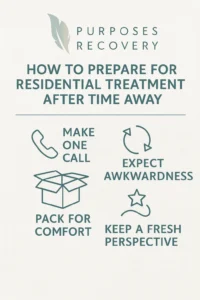
Expect Some Awkwardness—and That’s Okay
When you come back to treatment after time away, there can be some emotional weirdness. You might recognize the staff or some of the community. You might worry people will judge you.
You’re allowed to feel awkward. But that doesn’t mean you don’t belong.
The truth? Most people in residential treatment get it. Many have left and come back. The fear you’re carrying isn’t a red flag—it’s a sign you still care.
You don’t have to tell your whole story. You can start with:
“I needed time. I’m back now.”
That’s more than enough.
Let Yourself Feel New—Even If This Isn’t Your First Time
Reentry isn’t just a return—it’s a beginning.
Even if you’ve been through treatment before, you aren’t the same person. You’ve lived more life. Felt more pain. Gathered more insight.
Let yourself have a fresh start. Maybe this time, you’ll connect with a different therapist. Maybe you’ll hear something in group that actually lands. Maybe you’ll rest—really rest—for the first time in months.
You’re not back at square one. You’re further along than you think.
Residential Treatment in Los Angeles Can Be a Soft Landing
At Purposes Recovery, our residential treatment program in Los Angeles is designed to meet you where you are—even if that place feels unsure, messy, or inconsistent.
Whether this is your first time considering residential care or a return after IOP, we believe everyone deserves a space to regroup without shame.
From the moment you arrive, you’ll be surrounded by:
- A team that understands recovery isn’t linear
- Peers who have probably felt what you’re feeling
- Daily structure that offers stability without overwhelm
FAQ: Returning to Residential Treatment After Time Away
Is it normal to leave treatment and come back later?
Absolutely. Many people need more than one round of care—or a different level of support at different times. Coming back doesn’t mean you failed. It means you’re still in the process of healing.
Will I be judged for ghosting or not finishing a program?
Not at Purposes Recovery. Our team is trained to meet people with compassion, not judgment. You won’t be punished or shamed. We’ll simply help you figure out what you need next.
What if I’m not sure residential is right for me?
That’s okay. Our admissions team can talk you through your options. Sometimes, residential is the right step after outpatient didn’t feel like enough. Sometimes, another level of care fits better. You don’t have to decide alone.
Do I have to explain everything that happened while I was gone?
No. You share what you want, when you’re ready. There’s no required confession. What matters is what you need going forward, not what happened during your time away.
How quickly can I re-enter treatment?
Every situation is different, but if beds are available, we can often move quickly. If we need to verify insurance or coordinate details, we’ll walk you through each step so it doesn’t feel overwhelming.
📞 Feeling the nudge to try again—gently, this time?
Call (888)482-0717 or visit to learn more about our residential treatment program services in Los Angeles, CA, Illinois, Indiana, Kansas, New Jersey, New York, Ohio. No shame. No lectures. Just support.