
Your daughter says she’s fine. Your son shrugs off your questions. If treatment is on the horizon, learning about reintegrating after a residential treatment program can help your family prepare. They sleep all day, barely eat with the family, ignore texts, and disappear behind a closed bedroom door. And somehow, the silence feels louder than any argument ever could.
For many parents, this is the hardest part: not knowing whether what you’re seeing is temporary burnout, a rough season, or something more serious. Sometimes weekly therapy helps. Sometimes it’s not enough. And knowing the difference can feel terrifying. If something deeper is happening, learning how a partial hospitalization program helps your teen is a strong starting point.
If you’ve started wondering whether your adult child needs more support than a one-hour appointment each week, you’re not overreacting. You’re paying attention. Families exploring round-the-clock mental health support often arrive at that realization slowly, painfully, and with a lot of self-doubt along the way.
Isolation Can Become Its Own Kind of Gravity
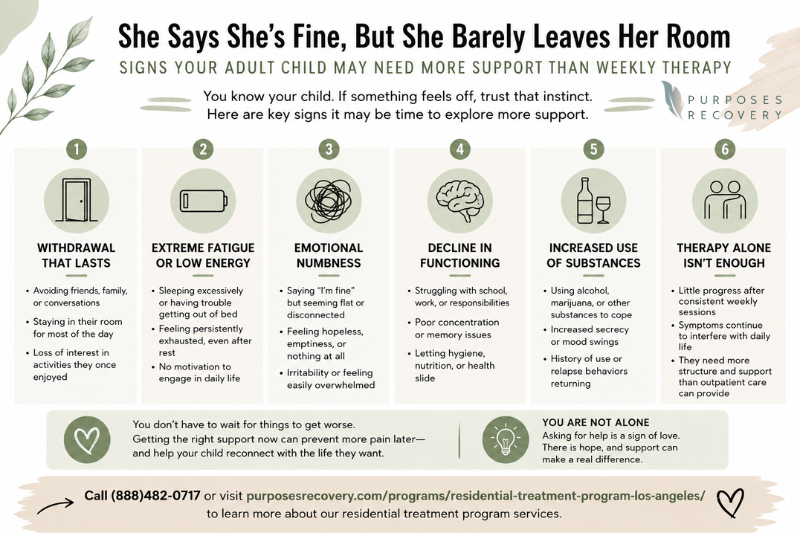
Depression doesn’t always look dramatic. Sometimes it looks like withdrawal so gradual you almost miss it. Understanding enabling and how to avoid it can help you respond to those shrugs with clarity instead of fear.
A 22-year-old who used to laugh at dinner now eats alone upstairs. A once-ambitious college student suddenly drops classes without explanation. Someone who used to spend hours with friends now barely responds to messages.
Over time, their world gets smaller and smaller.
Isolation has a strange momentum to it. The longer someone stays disconnected, the harder it becomes to re-enter life. Even simple tasks can start to feel emotionally expensive. Showering. Answering a call. Leaving the house.
Parents often tell themselves, “They’re young. Maybe they’re just figuring things out.”
And sometimes that’s true.
But deep emotional pain often hides behind phrases like:
- “I’m just tired.”
- “I don’t feel like talking.”
- “I’ll deal with it tomorrow.”
- “Nothing sounds good anymore.”
Those can be subtle signs of severe depression, especially when they persist for weeks or months rather than days.
Weekly Therapy Sometimes Isn’t Enough Structure
Therapy can be incredibly helpful. But therapy alone isn’t always enough for someone whose entire daily rhythm has collapsed.
If your adult child spends 167 hours a week overwhelmed, disconnected, emotionally numb, or using substances to cope, one hour of support may not be enough to interrupt the cycle.
That doesn’t mean therapy failed.
It means their nervous system may need more consistent care, more structure, and more support than outpatient sessions can realistically provide right now.
Think of it this way: if someone is drowning emotionally, weekly therapy can feel like handing them a towel while they’re still underwater. This guide to supporting a loved one’s recovery can help you show up without pushing them away.
Some young adults benefit from more immersive care environments that help rebuild sleep routines, emotional regulation, nutrition, connection, and safety at the same time.
The “Fine” They’re Showing You Might Be Survival Mode
Many struggling young adults become experts at minimizing their pain.
Not because they’re manipulative. Often because they don’t want to scare you. Or disappoint you. Or because they genuinely don’t know how to explain what’s happening inside them.
Parents sometimes expect severe emotional distress to look obvious. But high-risk depression can still exist alongside:
- scrolling TikTok for hours
- joking occasionally
- going to work sometimes
- saying “I’m okay”
- appearing emotionally flat instead of openly sad
Numbness is still suffering.
One of the more painful realities of depression is that it can erase a person’s ability to imagine feeling different. They stop reaching for help because hopelessness starts feeling logical.
That’s why waiting for someone to “want help badly enough” can become dangerous.
Substance Use Often Complicates the Picture
For some families, there’s another layer underneath the isolation: substances.
Maybe your child drinks heavily at night. Maybe they started smoking more marijuana after becoming withdrawn. Maybe they were in recovery before and now you’re noticing old patterns returning.
Parents often get stuck trying to determine which came first:
- the depression
- the substance use
- the withdrawal from life
In reality, these issues frequently feed each other.
Depression can make substances feel like relief. Substances can intensify depression. Shame grows. Motivation drops. The cycle tightens.
And many young adults become trapped in a strange middle ground where they’re functioning just enough to avoid immediate crisis — but not enough to truly live.
That gray area is where families often suffer the most confusion.
A Parent’s Instinct Matters More Than You Think
You don’t need perfect proof to take your concern seriously.
Parents often talk themselves out of their intuition because their child is technically an adult. They worry about being controlling. Dramatic. Intrusive.
But noticing changes is not the same as controlling someone.
You know your child’s baseline. You know the difference between needing space and disappearing emotionally.
If you’ve been carrying a quiet fear that “something is really wrong,” it’s worth listening to that feeling with compassion instead of shame.
A helpful question is not:
“Are they bad enough for help?”
A better question is:
“Are they suffering more than they’re able to manage safely on their own?”
That shift matters.
Support Can Look Bigger Without Being Punishment
One reason families hesitate to explore higher levels of care is fear.
Fear that their child will feel trapped. Fear they’ll refuse. Fear that seeking more support means things have become hopeless.
But increased support is not a punishment for falling apart.
For many young adults, live-in treatment provides something they haven’t felt in months or years: relief from carrying everything alone.
More consistent support can create space for:
- stabilization
- medication evaluation
- deeper therapy work
- rebuilding routines
- healthier sleep
- reduced substance use
- emotional safety
- reconnection with themselves
Sometimes healing starts with structure before motivation returns.
And sometimes the bravest thing a family does is stop minimizing how much pain everyone has been carrying.
If your family has been trying to hold this together quietly for a long time, exploring live-in mental health treatment options may help you understand what level of care actually fits the situation. This clinician’s guide on whether is a residential treatment program necessary was written for parents seeing exactly these patterns.
Your child is still in there, even if depression has made them hard to reach right now.
Call (888)482-0717 or visit our residential treatment program services to learn more about our residential treatment program services.