
I remember sitting in my car outside a meeting after I relapsed, staring at the steering wheel like it had answers. Ninety-three days sober. Gone. At least that’s what I told myself.
The truth took longer to understand.
Nothing was gone. I was still alive. Still hurting. Still capable of getting help again.
For a lot of people, questions about addiction treatment aren’t really about timelines. They’re about fear. Fear of disappearing from work. Fear of disappointing people again. Fear that if the first stay didn’t “fix” everything, maybe nothing will.
That’s part of why people quietly search things like how long is inpatient rehab late at night, trying to figure out whether going back means starting from zero. It doesn’t.
And if you’re considering returning to live-in treatment after a relapse, you deserve an honest answer—not a sales pitch.
The First Few Days Usually Feel Longer Than the Entire Stay
Most people don’t remember every therapy group or schedule from treatment.
They remember the feeling of walking back through the door.
The shame. The awkwardness. The internal voice saying, You should’ve been stronger than this.
But relapse has a strange way of making people forget how hard recovery already was. You didn’t fail because recovery was easy and you somehow messed it up. You relapsed because addiction is persistent, isolating, and deeply tied to stress, pain, loneliness, trauma, or exhaustion.
Sometimes people return for a shorter stay. Sometimes they need more time than before. Both are normal.
What matters most is honesty—not perfection.
Recovery Doesn’t Follow a Calendar
A lot of alumni secretly want a number.
Thirty days. Sixty days. Ninety days.
Something clean and measurable.
But healing rarely works like that. Some people stabilize quickly once substances leave their system and structure returns. Others realize the relapse uncovered deeper things they never fully addressed the first time around.
Grief. Burnout. Anger. Trauma. The exhausting pressure of trying to look okay.
A short stay can help someone interrupt a dangerous spiral. A longer stay can give someone enough space to actually breathe before rushing back into real life.
Neither approach means you’re “better” or “worse” at recovery.
The Quiet Danger of Leaving Too Early
This is the part people don’t always talk about openly.
Sometimes we leave treatment the second we start feeling slightly better—not because we’re ready, but because discomfort starts easing and our brain convinces us we’re fine again.
Addiction can be sneaky like that.
It’s a little like leaving a cast on for two weeks because the bone hurts less. Pain fading isn’t the same thing as healing.
I’ve watched people walk out early because they were scared to lose momentum in life, only to lose far more trying to manage everything alone again.
That doesn’t mean longer treatment is always the answer. It means honesty matters more than pride.
Some People Return Stronger the Second Time
Not because relapse was “good.”
Not because it was necessary.
But because it stripped away the fantasy that recovery could survive on willpower alone.
There’s often a different kind of openness after relapse. Less performance. Less trying to say the right thing in group. Less pretending everything’s under control.
And strangely, that honesty can become solid ground.
“The second time I went back, I stopped trying to graduate treatment like it was a competition. I finally started listening.” — Alumni Reflection
That shift matters.
Especially for people who spent their first stay trying to prove they weren’t “that bad.”
You’re Allowed to Need More Support Than You Expected
There’s this invisible pressure in recovery to make your first attempt look perfect.
As if needing additional treatment somehow cancels out the progress you already made.
It doesn’t.
Those ninety days still mattered. The meetings mattered. The sober mornings mattered. The relationships you repaired mattered.
Relapse doesn’t erase growth any more than one storm erases an entire season.
And honestly? A lot of people who stay sober long term have chapters they don’t post about. Restarts. Slips. Returns. Humbling moments that eventually became turning points.
The Real Question Usually Isn’t About Time
Underneath the search for timelines is usually another question:
“Will it even help if I go back?”
That answer is personal. But many people find that returning to structured, round-the-clock support gives them something they lost after relapse: rhythm.
Sleep again. Meals again. Conversations that aren’t fake. Space away from chaos. A chance to hear themselves think.
Not forever. Just long enough to reconnect to the version of themselves that still wants a life beyond survival.
And that person is probably still in there, even if you can’t feel them right now.
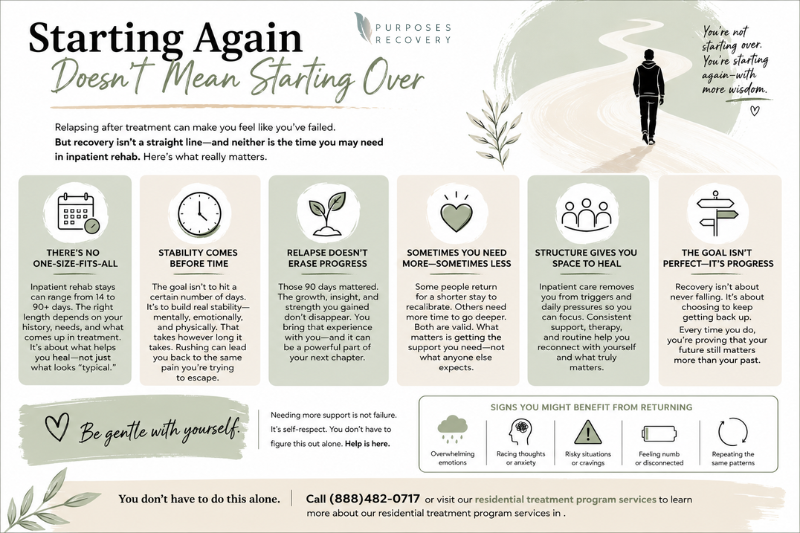
Starting Again Isn’t the Same as Starting Over
There’s a difference.
Starting over implies everything before this was meaningless.
Starting again means you’re carrying experience with you—even painful experience.
You know more now. About your triggers. About your blind spots. About what isolation does to you. About what happens when stress builds quietly for too long.
That knowledge matters.
And sometimes the bravest thing an alumni can do is walk back through the door before things get worse.
If you’re wondering whether it’s time to reconnect with support, Purposes Recovery offers compassionate residential treatment program services designed for people who need space to stabilize, regroup, and heal without judgment.
Call (888)482-0717 or visit our residential treatment program services to learn more about our residential treatment program services.