
You’ve been showing up. You’ve been trying. And still, something feels… stuck.
If you’ve found yourself wondering whether once-a-week therapy just isn’t cutting it anymore—but the idea of something more intense feels overwhelming—you’re not alone in that tension. It’s a very real place to be.
We see it every day.
And there are ways forward that don’t require jumping straight into round-the-clock care. You can explore structured daytime care options at your own pace—without losing your sense of control.
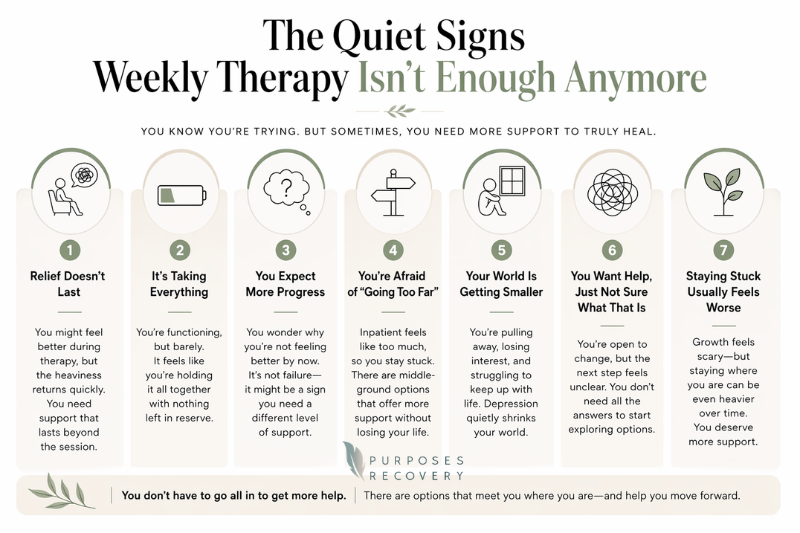
You Leave Sessions Feeling Relieved—But It Doesn’t Last
Therapy can feel like a breath of air. For an hour, things make sense. You feel heard.
But by the next day—or even that same evening—you’re back in it. The heaviness returns. The same thoughts loop.
That doesn’t mean therapy isn’t working. It might mean you need more support between sessions.
Sometimes healing needs more than a weekly checkpoint. It needs continuity.
You’re Functioning… But It’s Taking Everything You Have
From the outside, you might look okay.
You’re working. Showing up. Responding to texts. Getting through the day.
But inside? It’s exhausting.
You might feel like you’re holding everything together with invisible threads—and one small thing could unravel it.
That kind of quiet burnout often signals something important: you don’t need to push harder. You may need more support around you.
You Keep Thinking: “This Should Be Helping More By Now”
This thought can carry a lot of guilt.
You might wonder if you’re doing therapy wrong. Or if something’s wrong with you.
But here’s the truth: different levels of care exist for a reason.
Weekly therapy is helpful—but it’s not designed to carry someone through deeper or more persistent depression on its own.
Wanting more support doesn’t mean you’ve failed. It means you’re paying attention.
You’re Afraid of “Going Too Far” With Treatment
This is where many people get stuck.
You know you need more help—but the idea of live-in treatment feels like too much. Too intense. Too disruptive.
So you stay where you are. Even if it’s not working.
There’s a middle ground that often gets overlooked. Structured, multi-day support during the day—without giving up your entire life.
That’s why people start exploring alternatives to inpatient depression care. Not because they’re avoiding help—but because they’re trying to find something that actually fits.
Your World Is Getting Smaller
Depression has a way of shrinking things.
You might notice:
- You’re canceling plans more often
- Your energy for basic tasks is fading
- Things you used to enjoy feel distant or flat
It doesn’t always happen dramatically. Sometimes it’s subtle. Gradual.
But if your life is getting smaller, it’s worth asking whether your support system needs to get bigger.
You Want Help—You’re Just Not Sure What That Looks Like Yet
This might be the most honest place to start.
You don’t need to have it all figured out. You don’t need to commit to anything today.
You just need to stay open to the idea that feeling this way doesn’t have to be your baseline.
There are ways to get more support without losing yourself in the process.
A Different Kind of Step Forward
Starting something new can feel scary. That’s real.
But staying stuck has its own weight. And over time, it usually gets heavier.
The goal isn’t to overwhelm you. It’s to help you find a level of care that actually supports you—consistently, gently, and without judgment.
If weekly therapy has brought you this far, that matters. It means you’ve already started.
You don’t have to stop there.
If you’re beginning to wonder what more support could look like, we’re here to help you explore it—without pressure.
Call (888)482-0717 or visit our partial hospitalization program services in Los Angeles, CA to learn more.