
You can read all the websites in the world and still not know what your actual week would feel like in treatment.
That’s usually the real question behind searches like day hospital vs iop. Not “Which one is clinically better?” but: How much of my life will this take over? Will I still work? Drive? Sleep at home? Feel human?
At Purposes Recovery, we hear that fear constantly. And for many people exploring structured daytime care, the reality is less scary — and more supportive — than they expected.
Most People Picture Something Much More Extreme
A lot of sober curious adults assume treatment means disappearing from normal life overnight.
They imagine locked doors. Endless group therapy. Being cut off from work, family, or reality itself.
But structured daytime care often looks more like rebuilding rhythm than losing freedom.
You wake up at home. You get dressed. You attend treatment during the day. Then you return to your own space at night with actual tools to handle cravings, anxiety, stress, or emotional burnout in real time.
That difference matters.
Especially for people who are functioning on the outside while quietly unraveling underneath.
A Typical Week in Structured Daytime Care
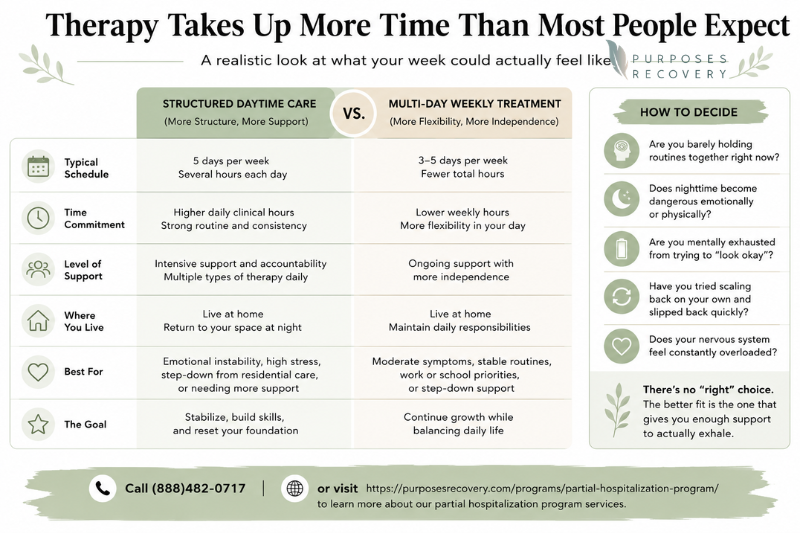
This level of care usually runs five days a week for several hours each day.
Your schedule may include:
- Group therapy
- Individual counseling
- Trauma work
- Psychiatric support
- Skill-building sessions
- Recovery planning
- Meals or wellness support
- Time to process instead of constantly perform
The biggest surprise for many clients? The pace slows them down enough to finally hear themselves think.
One client described it like this:
“I thought treatment would feel like punishment. It actually felt like someone finally helped me put my nervous system down for a minute.”
That’s the part people rarely expect.
Multi-Day Weekly Treatment Usually Leaves More Room for Life
Multi-day weekly treatment tends to involve fewer hours per week.
You might attend care in the mornings or evenings several days a week while continuing work, school, parenting, or other responsibilities.
For some people, that flexibility is exactly what helps recovery feel possible.
For others, it’s not enough structure yet.
And that’s where confusion around day hospital vs iop usually starts. People assume “less intense” automatically means “better” because it feels less disruptive.
But sometimes the opposite is true.
Sometimes trying to heal while carrying your full normal life at the same time feels like trying to repair a roof during a hurricane.
The Real Difference Is Often Emotional Bandwidth
This decision usually has less to do with labels and more to do with capacity.
Ask yourself:
- Are you barely holding routines together right now?
- Does nighttime become dangerous emotionally or physically?
- Are you mentally exhausted from trying to “look okay”?
- Have you tried scaling back on your own and slipped back quickly?
- Does your nervous system feel constantly overloaded?
If so, more support may feel relieving instead of restrictive.
That realization catches many people off guard.
Especially high-functioning adults who assumed they should be able to manage everything privately.
Here’s What the Schedules Actually Feel Like
A simple comparison helps.
| Structured Daytime Care | Multi-Day Weekly Treatment |
| Usually 5 days/week | Usually 3–5 days/week |
| More daily clinical hours | Fewer total hours |
| Higher level of support | More independence |
| Stronger routine and accountability | More flexibility around work/life |
| Often ideal after residential care or during emotional instability | Often ideal for step-down support or moderate symptoms |
Neither option is “better.”
The better fit is the one that gives you enough support to actually exhale.
Recovery Usually Starts Getting Better the Moment You Stop Performing
Many sober curious adults spend years negotiating with themselves before they ever ask for help.
Not because they’re unwilling.
Because they’re tired of dramatic narratives that don’t sound like them.
You do not have to hit a catastrophic rock bottom to deserve support.
Sometimes the sign is quieter than that.
You’re functioning. But every day feels heavier than it should.
You’re getting through life instead of living it.
And honestly? That’s exhausting in its own way.
It’s Okay to Need More Structure Than You Expected
There’s a strange relief that happens when people stop trying to white-knuckle everything alone.
Not weakness. Relief.
The right level of care shouldn’t make you feel trapped. It should make you feel less alone inside your own mind.
If you’re exploring whether a more structured approach makes sense, our partial hospitalization program can help you understand what daily support actually looks like — without pressure or judgment.
Call (888)482-0717 or visit our partial hospitalization program services to learn more about our partial hospitalization program services.