
You’re competent. You’re reliable. You’ve built systems, schedules, reputations, and personas that tell the world you’re “fine.” You manage crises, calendars, finances, relationships—and yes, you even manage your substance use so that it doesn’t “look bad” to anyone. But deep down, the idea of a partial hospitalization program triggers something: a threat, a loss, a vulnerability you’ve worked for years to bury.
Let’s sit with that for a minute. You’re not weak. You’re worn. And the fear you feel about structured treatment isn’t a flaw—it’s a defence you’ve refined over years. But what if that very defence is now what’s stopping you from changing the thing that’s slowly eating you alive?
You might be reading this from Indiana, or maybe your work has taken you through different states like Kansas—but regardless of where you are, the emotional pattern looks the same. High‑functioning people who struggle internally tend to fear solutions that feel like loss of control even if those solutions are exactly what they need.
Below, we’ll unpack why that fear exists, how it protects you and how it traps you—and how a partial hospitalization program can actually return control to your life instead of taking it away.
When Control Is the Coping Mechanism
For high‑functioning people, control isn’t just a preference. It’s survival.
You learned early that unpredictability hurts. You learned that chaos demands capitulation. So you developed rituals: carb counting, color‑coded calendars, extra work to cover emotional gaps, drinks that “calm the edges,” substances hidden in travel mugs, or evenings buffered with numbing routines.
Control became a language you speak fluently.
That’s why when someone suggests a partial hospitalization program—a structured, supervised care environment—it feels like a blasphemy against your instincts. It feels like a parent telling you what to do. It feels like confession. It feels like defeat.
But here’s the hard truth that only people willing to get honest with themselves will hear:
What you’re calling “control” may actually be fear disguised as competence.
When you manage everything externally—your schedule, your image, your performance, your intake—you’re not controlling your inner world. You’re just papering over it.
A partial hospitalization program isn’t about taking control away. It’s about teaching you how to use control for you instead of against you.
Why Structured Care Feels Like a Threat
Let’s break down what your brain is actually saying when it balks at structured treatment:
- “If I need help, I’m a failure.”
- “If I can’t manage this on my own, I’m weak.”
- “People will judge me.”
- “I’ll lose my job/respect/identity.”
Do you hear the common thread? It’s not about care—it’s about identity.
High‑functioning people tie self‑worth to independence and productivity. If you’re seen as needing help, you fear you’ll be seen as flawed, unworthy, or untrustworthy.
But hear me: that’s shame talking—not reality.
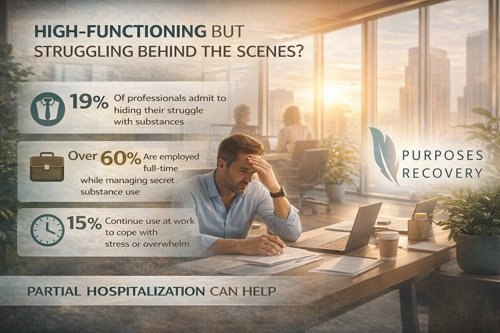
A partial hospitalization program is a treatment pathway for people who still function, but not in the way they want to anymore. It’s for the person who shows up on time but dreads mornings. For the person who never misses a deadline but hides broken nights of sleep. For the person who jokes about their drinking or drug use—but only when they think no one is listening too closely.
People walk into a PHP not because they’ve hit rock bottom, but because they’ve plateaued in enough pain that continuing the old way feels worse than trying something new.
The Fear of Vulnerability
You’re not afraid of change. You’re afraid of being seen.
High‑functioning people hate loose ends—and emotions are the loosest, messiest, most unpredictable part of life. Vulnerability means unpredictability. Vulnerability means not knowing how others will respond.
So you manage, you mask, you mitigate. You work harder. You talk faster. You laugh louder.
But vulnerability isn’t a weakness. It’s a doorway.
It’s the door that a partial hospitalization program opens—not to expose you, but to help you learn how to stand in your truth without crumbling.
In treatment, vulnerability isn’t a liability. It’s a skill you develop.
What a Partial Hospitalization Program Actually Is
You might be picturing a locked ward. Or 24/7 hospitalization. Or chaos and breakdowns reminiscent of films and TV.
That’s not what a partial hospitalization program is.
A PHP is structured outpatient care. It gives you:
- Daily clinical support with therapists and medical professionals
- Group process with peers who are also managing life while healing
- Tools for managing triggers, stress, cravings, and emotions
- A space to understand—not just survive—your patterns
- A bridge between your “functioning life” and a life you actually enjoy living
Think of it like training with a coach instead of running another mile by yourself in silence.
This isn’t weakness. It’s strategy.
You Fear Losing Control—but What You’ve Really Lost Is Peace
You might say: “I don’t need people telling me what to do.”
But the real question is: Do you still need to tell yourself what to do… every hour of every day?
People who are used to control often overlook the emotional cost of that control:
- Exhaustion
- Dissociation
- Secret rituals
- Shame hiding under achievement
- Numbing that grows quieter but more insistent
- Humor used as deflection
- Anger disguised as efficiency
You don’t look broken. But you feel fractured.
A partial hospitalization program doesn’t take your autonomy. It gives you peace.
Autonomy without awareness is just chaos in pretty packaging.
The Paradox of Help for High‑Functioning People
Here’s a line people don’t like to hear—but they need to:
The more competent you are, the longer you can pretend you don’t need help.
And the longer you pretend, the deeper the pain hides.
You’re not one of those people who breaks visibly. You break invisibly—by continuing to sacrifice emotional and psychological health on the altar of performance.
And then you wonder why you’re exhausted.
A partial hospitalization program is not a concession. It’s a conscious decision to stop managing symptoms and start healing causes.
How Control Shows Up in Treatment
Let’s be blunt: you will try to control treatment.
You’ll want to:
- Attend only the sessions you think are necessary
- Show only your polished thoughts
- Talk about everything but the real issue
- Frame your narrative so you look like the “success story” before you even begin
That’s familiar territory. But here’s the clinician truth:
The work isn’t what you can pretend through.
The work is what you can be honest about.
And honesty doesn’t feel like control at first. It feels like surrender.
But surrender is not defeat. It’s strategy.
What Happens When You Let Go Enough to Let Healing Begin
People often report:
- Sleeping better
- Feeling lighter
- Thinking more clearly
- Facing situations they once avoided
- Repairing relationships
- Reducing or stopping use
- Reconnecting with joy
- Setting boundaries without overthinking
Not because they were weak.
But because they stopped fighting themselves.
You have been your own most consistent opponent. What if for once you had a team?
A partial hospitalization program is that team.
Real People, Real Transformation
Here’s what people in structured care often say:
“I thought I needed to control everything. I didn’t realize I was controlling my own suffering.”
“I was afraid of judgment, but the real judgment was me judging myself.”
“I thought functioning was living. I learned functioning was coping—and healing is living.”
Functional isn’t the finish line. Peace is.
The Cost of Waiting
You might still think:
“Maybe I can do this on my own a little longer.”
But that “little longer” is a trap. It’s the comfortable continuation of discomfort.
High‑functioning people are experts at postponing healing:
- Next Monday
- After this quarter
- When the project ends
- After this trip
- Once I prove myself first
But addiction and emotional pain don’t wait. They burrow.
And when they burrow, they become harder to treat.
A partial hospitalization program meets you before the break becomes a fracture.
FAQs About Partial Hospitalization Programs
Q: Do I have to stop working or living my life to join a PHP?
A: No. A partial hospitalization program is designed to allow you to live at home and continue responsibilities while receiving structured daily therapeutic support.
Q: Will people judge me for being in treatment?
A: The fear of judgment is normal, but most people find that peers in treatment are compassionate and non‑judgmental. Often the judgment you fear is harsher in your head than in reality.
Q: Can a partial hospitalization program help with substance use even if I seem “okay” to others?
A: Absolutely. High‑functioning substance use often hides behind competence. PHP helps address both the behavior and the underlying emotional patterns.
Q: Is PHP only for people who have “hit rock bottom”?
A: No. PHP is for anyone whose current way of coping is no longer sustainable or fulfilling—even if they still perform well externally.
Q: How long does a partial hospitalization program typically last?
A: Duration varies by individual needs, but the focus is on measurable progress in skills, insight, and stability—not arbitrary timelines.
If you’ve ever wondered what it would feel like to stop managing your suffering and start living again, that’s your answer whispering in your ear.
Call (888)482-0717 to learn more about our partial hospitalization program in Venice, CA.