
You didn’t picture this at graduation.
Not at 18. Not at 20. Not now.
You raised them with love, rules, values. You talked about consequences. You did your best. And still, here you are—Googling detox programs at 2AM while their phone goes straight to voicemail.
If you’re afraid your child is using again—and it’s starting to look like something worse than “just a phase”—you’re not alone. You’re not crazy. And no, you’re not a bad parent.
You’re scared. And you’re trying to figure out whether a medical detox program is the right next step.
So let’s talk—parent to parent.
Purposes Recovery’s medical detox program in Los Angeles exists for moments like this—when you know something has to happen, and you’re the only one making the call.
What is a medical detox program—and how is it different from rehab?
This is one of the most common (and most important) questions.
A medical detox program is a short-term, medically supervised program designed to help your child safely withdraw from drugs or alcohol. It’s not rehab. It’s what comes before rehab—or sometimes, what makes rehab possible.
Here’s the difference:
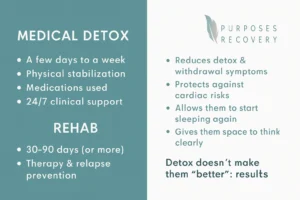
- Detox: A few days to a week. Focused on physical stabilization. Medications are used (if needed) to manage withdrawal symptoms. 24/7 clinical support.
- Rehab: 30–90 days (or more). Focused on therapy, structure, relapse prevention, and long-term recovery tools.
If they’re actively using right now—especially daily—detox is almost always the first step. You can’t build recovery on a body that’s still in survival mode.
What does detox actually do for my child?
The short version: it gives their brain and body a break.
The long version:
- It reduces cravings and withdrawal symptoms
- It protects against seizures, dehydration, and cardiac risks
- It allows them to start sleeping again
- It separates them from chaos (and their dealer, and their phone, and their triggers)
- It gives them space to think clearly for the first time in weeks or months
Detox doesn’t make them “better.” But it makes better possible.
Will they be safe—even if they’re not emotionally stable?
Yes. Especially then.
Our medical detox program is designed not just for substance withdrawal, but for emotional overwhelm. Many of our clients arrive in a mix of:
- Anxiety and rage
- Depression and numbness
- Shame and defiance
- Hopelessness that looks like silence
We don’t require people to be calm or cooperative or grateful on Day 1. We expect distress. We’re trained for it. And we respond with calm, medical care—not control or judgment.
This may be the first place where someone looks at your child’s pain and says, “We’ve got you. You don’t have to hold this alone.”
What if they don’t think they need help?
You’re not imagining it—they may genuinely believe they’re fine.
But if you’re reading this, you already know the truth: they’re not.
Substance use convinces people they’re “not that bad.” That they’ve “got it under control.” That they’ll stop—tomorrow. It’s not always lying. Sometimes it’s fear. Sometimes it’s just the part of their brain that’s been hijacked.
You don’t need them to be fully on board to get help started.
At Purposes Recovery, we help families navigate:
- Pre-admission planning
- “Soft” conversations that open the door
- Coordinated interventions (formal or informal)
- Gentle approaches that don’t escalate chaos
Sometimes the call comes from a parent. Sometimes it’s a whisper from the client themselves. Both are valid.
Can I get them admitted even if they refuse?
That depends.
If they’re over 18 and not under legal guardianship, they must consent to treatment. We can’t force adults into detox (except in very rare legal or medical exceptions). But that doesn’t mean you’re powerless.
What you can do:
- Set boundaries around access to money, housing, or transportation
- Talk to our admissions team for coaching on how to open the door without triggering resistance
- Create a safety plan for the next moment of readiness (and it will come)
- Prepare now so you don’t scramble later
We’ve helped many “never gonna go” clients enter detox with dignity—because their parent stayed steady and got support behind the scenes.
What if they leave early? Will it still help?
Yes. Even a few days in detox can make a difference.
- It reduces immediate health risks
- It helps lower the risk of overdose if they use again
- It introduces them to treatment without pressure
- It plants a seed for when they’re truly ready
- It gives you space to breathe, regroup, and get support
Of course we want them to stay the full course. But if they don’t? That’s not failure. It’s a beginning. And they’ll remember how it felt to be held without judgment. For some individuals, when detox is the missing piece of recovery, even a brief experience with compassionate, medically supervised care can become the turning point that encourages them to seek help again when they’re ready.
They’ve done detox before. Why would this time be different?
Because readiness changes. Because trauma gets triggered. Because the right place at the right moment can flip the switch from surviving to healing.
If past detox experiences were rushed, chaotic, or didn’t include emotional support, your child might still be running from that. That’s why we’ve built something different.
At Purposes Recovery:
- We don’t treat people like problems to manage
- We allow space for the emotions underneath the addiction
- We include families, when appropriate
- We meet people where they are—not where we wish they were
This time could be the one that sticks. But it starts with safety.
Will they be drugged up or sedated the whole time?
No.
This is a common and understandable fear, especially if you’ve seen treatment centers that overuse medication or leave people dazed.
We use medication only when clinically appropriate and always with the goal of stabilization—not sedation. Most clients report feeling clearer, more grounded, and more capable after detox—not “zombied out.”
We believe people heal better when they feel human.
What happens after detox?
Detox is step one. After that, we help guide the next right step—which could be:
- Residential treatment (if deeper healing is needed)
- Intensive outpatient care (IOP in Los Angeles)
- Therapy or psychiatric care
- Medication-assisted treatment
- Sober living
- Support for returning home with a plan
Nothing is forced. Nothing is rushed. But we don’t leave them hanging, either. We walk with them—and with you.
What should I do while they’re in detox?
This part’s hard. But it matters.
- Get rest. You’ve been in crisis for longer than you realize.
- Talk to someone—therapist, support group, friend, us.
- Resist the urge to micromanage from a distance.
- Breathe. Let the professionals hold your child for a few days.
- Make space for grief, anger, relief—all of it is valid.
You don’t have to fix them. You just have to love them in a way that includes you too.
How do I know it’s time to make the call?
You already know.
If you’re scared, if your gut says “this isn’t just partying anymore,” if you’re checking their breathing at night or watching their eyes for signs of something…
It’s time.
And if you’re still unsure, just call.
Our team will talk it through with you—calmly, compassionately, without pressure. You don’t have to do this perfectly. You just have to reach out.
One More Thing, From One Parent to Another
You didn’t cause this.
You didn’t fail.
You’re not weak for crying, or raging, or whispering “I can’t do this anymore.”
A medical detox program won’t fix everything. But it’s a step toward clarity. Safety. Breath. And hope—for your child, yes, but also for you.
Call (888)482-0717 or visit our Medical Detox Program in Los Angeles, Illinois, Indiana, Kansas to speak with someone who gets it. You’re not alone—and you don’t have to carry this by yourself anymore.