
If you’ve been thinking about getting help but keep getting stuck on one question—how will I make this work with my life?—you’re not alone.
Many people who are sober curious or exploring treatment aren’t worried about whether support could help. They’re worried about logistics. Work. Family. Appointments. Responsibilities. That’s why understanding what a structured schedule actually looks like can make the decision feel less overwhelming.
At Purposes Recovery, we help people evaluate whether a partial hospitalization program fits their goals, needs, and daily life.
Start by Looking at What Your Days Already Demand
Before thinking about treatment, take inventory of your current schedule.
What commitments absolutely cannot move?
Maybe you’re caring for children. Maybe you’re working remotely. Maybe you’re balancing both while quietly trying to hold everything together.
The goal isn’t to find a perfect opening in your calendar. It’s to understand where support could realistically fit.
Many people are surprised to learn that structured daytime care is designed for people who still have lives, responsibilities, and obligations outside of treatment.
Be Honest About What’s Already Taking Your Time
Here’s a difficult question:
How much time is your current situation already consuming?
For people questioning their relationship with alcohol or other substances, a significant amount of mental energy often goes toward planning, recovering, worrying, hiding, negotiating, or simply trying to feel okay.
Treatment does require a time commitment. But sometimes the bigger question is whether the current struggle is already costing more time than you realize.
Think of it like carrying a backpack filled with rocks. At some point, putting the backpack down becomes more efficient than figuring out how to carry it better.
Understand What a Typical Week May Look Like
One of the biggest fears people have is that treatment means disappearing from everyday life.
That’s not usually the case.
While schedules vary, structured daytime programs generally involve several hours of treatment during the day, multiple days each week. The exact day treatment hours per day depend on individual needs, clinical recommendations, and the specific program.
What matters most is understanding whether those hours can be coordinated around your responsibilities and whether the level of support matches what you’re looking for.
Think About What Happens Outside of Program Hours
Treatment isn’t only about the hours spent in groups, counseling sessions, or therapeutic activities.
It’s also about what happens when you go home.
Can you return to an environment that supports your goals?
Do you have enough flexibility in the evenings to process what you’re learning?
Will your schedule allow you to prioritize recovery without immediately becoming overwhelmed again?
These questions often matter just as much as the treatment schedule itself.
Consider Whether You Need More Than Weekly Support
Some people start looking at treatment because they’re curious.
Others start looking because they know something has to change.
If you’ve tried setting limits, taking breaks, moderating, or managing things on your own without lasting success, a higher level of structure may make sense.
The right schedule isn’t necessarily the shortest one. It’s the one that gives you enough support to create meaningful change.
Talk Through the Logistics Before Deciding
You don’t have to figure this out alone.
One of the most valuable conversations you can have is with an admissions specialist who can explain scheduling options, expectations, and how treatment may fit into your life.
Questions worth asking include:
- How many days each week would I attend?
- What are the typical daily hours?
- Can I maintain certain work or family responsibilities?
- What happens if my schedule changes?
- How do I know whether this level of care is appropriate for me?
Getting answers often reduces anxiety far more than endlessly searching online.
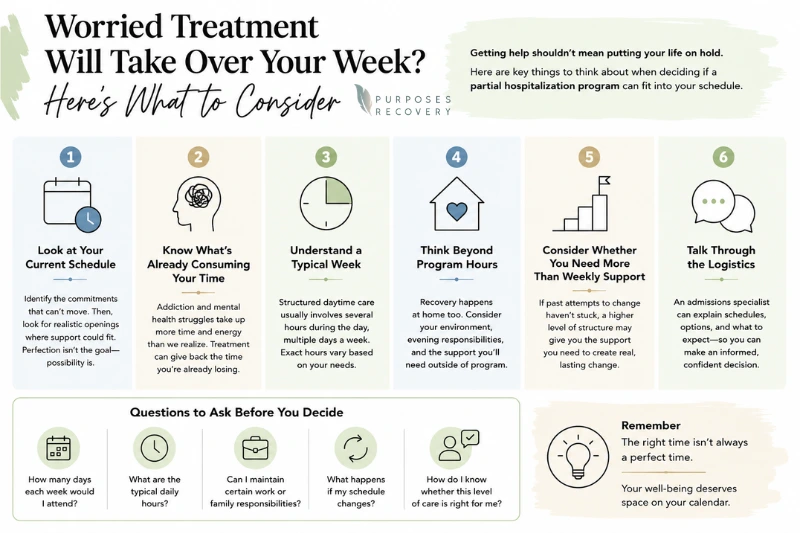
The Right Time Isn’t Always a Perfect Time
Many people wait for a magical moment when work slows down, stress disappears, and life becomes easier.
That moment rarely arrives.
The people who make meaningful changes are often the ones who decide their well-being deserves space in the calendar, even when life feels busy.
If you’re asking whether treatment can fit into your schedule, that may be a sign you’re already taking the possibility seriously.
Call (888) 482-0717 or visit our partial hospitalization program services to learn more about our partial hospitalization program services.